
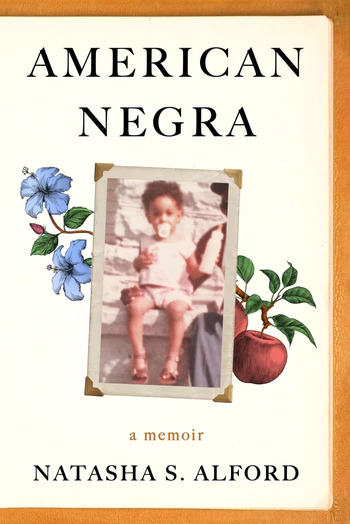
Let’s weave a story, beginning with an author. Let’s call this author Natasha S. Alford.
Natasha S. Alford is an award-winning American author, journalist, digital media executive, and public speaker. She is of Puerto Rican and African American descent, born in Syracuse, New York. Well acclaimed, Alford has received awards such as the Black Voices for Black Justice grant, a 2020 Poynter Women’s Leadership Academy certificate, and the 2017 Harvard Women’s Leadership award–to name a few–for her journalism work. She published her debut novel, the topic of this blog post, American Negra: a memoir, in 2024 and was awarded an International Latino Book Award for Best First Book.

The memoir explores the complexities of growing up multiethnic in America, intersecting with gender, identity, and belonging. It follows Alford from childhood, where she grapples with which side of her Puerto Rican and African American heritage she most identifies with, through her matriculation at Harvard in undergrad, and into her unpredictable career as a journalist striving to make a difference. She currently serves as Senior Vice President at TheGrio, a news, media, and lifestyle platform dedicated to Black stories and opinions.
Although a native of Syracuse, New York, Alford always understood that something was different about her. “What are you mixed with?” the neighborhood girls would pry as they convened as girls do. “I’m Puerto Rican and Black,” she’d respond, not so sure if she was deserving of the former. Her mother raised her familiar with Spanish, but only speaking English, which muddied the already tepid waters of her identity. Misguided by a [objectionably] well-meaning school counselor, Alford’s mother elected to teach her daughter English so she wouldn’t fall behind her peers academically. Unbeknownst to Mami, as Alford fondly refers to her mother throughout the memoir, this wouldn’t have anchored her in failure scholarly, but it would hamper her ability to connect with her Puerto Rican heritage. A trip to Puerto Rico leaves her not only ashamed of her lack of language, but recognizing that she doesn’t look like the rest of her family–in skin nor hair.
In African American salons, she’s acclaimed for her “good hair,” but Puerto Rican circles contradict that sentiment, coining her thick curls pelo malo, meaning bad hair. The evident relaxer would remove her from that liminal space, but it didn’t heal all. Alford’s incredible gift of speech would earn her columns in the newspaper; exciting pieces that would note her African American background, so that’s what stuck through adolescence to her mother’s dismay. She felt it important that Alford recognized that she wasn’t mixed–she just was.
As surely as the creamy crack burns, Alford was brilliant; a star that would earn not only admission to Harvard University, but scholarships to see her through. With every virtue comes a vice, and her transition from underserved public schools to a college of pedigree and privilege would unravel yet another bout with identity. She entered an entirely new world she never knew existed–most of us don’t, to her credit–and had no choice but to acclimate. Soon finding belonging in both Hispanic and African American campus clubs, she’d be uprooted by a crippling medical diagnosis. In this season of her life she learns just how resilient she truly is, leaning on her parents’ love and advice but holding her own self upright. A research trip to the Dominican Republic would be a testament to her resiliency, opening her up to another unfamiliar world–one that helps her understand exactly who she is and what Mami meant when she said she wasn’t mixed. She discovers Latinidad and dives into a rabbit hole defining identity, culture, ethnicity, heritage, and where she belongs in every facet.
American Negra: a memoir is a poignant reflection on the identities of young Afro-Latinxs who navigate the world under the false pretense that they must pick a side or straddle the uncomfortable “what are you mixed with” fence, when in reality they are a mosaic of heritage, culture, and every experience that evolves them. Most struggle because nobody tells them they can be Afro-Latinx–it’s not even recognized in the dictionary, let alone on a job application!
Though Alford grew to understand who she is, many aren’t afforded the opportunities that landed her in the Dominican Republic, and eventually into spaces where she could share stories and advocate for her people. I think it’s remarkable that Alford is acclaimed in both Black and Latinx categories, a good omen that awareness is about the children of these liminal spaces is traveling. It’s important that the African diaspora, recognizes Afro-Latinxs as members of our tribe because as noted in the video above by poet Melania Luisa Marte, the first thing that enters the room is her Blackness. It’s the first thing people will see before they hear her speak or read her name to ask, “what are you mixed with?” The slave trade began in Hispaniola, where many descendants of the Yoruba tribe would eventually revolutionize and win back their freedom. They are us and we are them. Together, we can all just be.
I implore each and every reader at the Braid Blog to read or listen to Alford’s eloquent memoir on identity and belonging. Though her heritage is specific, the message translate to all residing in the borderlands of multiple racial or ethnic backgrounds. I am monoethnic, but I resonated with Alford’s sentiments as an American born woman who was raised in purely Nigerian spaces. If anything, I felt less alone knowing that it wasn’t just me figuring out which side I mostly identified with and like the aforementioned poet stated, I had to understand that my Blackness preceded me before anyone could read my name to ask where I’m from. I hope you’re wrapped in the same warmth I felt unraveling this revelation. Thank you for reading.
Please like, share, and subscribe below. If you’ve already gratified yourself with this read, share your thoughts to expand our conversation. If not yet, do so and let us know how you interpret and digest Alford’s memoir. In the meantime, click the links below to get to know Natasha Alford a bit more.
P.S. While matriculating through my master’s program, I wrote an essay dissecting the intersection between colorism and hair texturism in Black and Latinx communities with reference to Alford’s memoir. Give it a read, if you will.


Join the conversation!