

Let’s weave a story, beginning with an author. Let’s call this author Kalynn Bayron.
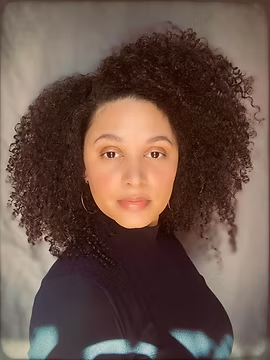
Kalynn Bayron is not only one of my favorite authors, but also the New York Times and Indie bestselling author of three of my favorite fantasy novels: Cinderella Is Dead, This Poison Heart, and This Wicked Fate. Properly acclaimed as a CILIP Carnegie Medal Nominee, a Bram Stoker Award nominee, a LOCUS Award finalist, and the recipient of the 2022 Randall Kenan Award for Black LGBTQ fiction, Bayron’s writing captivates readers who melt into stories dressed with riveting plots, mythological credos, and contemporary social undertones. As a social justice warrior who enjoys the imagery of a thaumaturgical world, I found myself particularly glued to Bayron’s collection of work. So much so that I reread all three before embarking on this review. Her work was also my introduction into Black-fantasy literature in my post grad season, a combination of genres I’d explored prior respectively but never imagined how rewarding they’d be as a pair. A step away from the academic literary canon definitely did me some good!
“I don’t want to be saved by some knight in shining armour. I’d like to be the one in the armour, and I’d like to be the one doing the saving.”
Kalynn Bayron, Cinderella Is Dead
Of the three aforementioned novels, I am particularly inspired by her debut novel Cinderella Is Dead. This story begins with sixteen-year-old Sophia, a queer Black girl living in a fairy-tale world where Cinderella’s story is not only real, but also the tenet of misogynistic social constructs that oppress women in a town called Lille. Similar to the patriarchal message in the original Cinderella story–that a man, a charming prince at that, will save girls from the terrors of the world–the message is weaponized to keep women subservient and centered on male appraisal. Set two hundred years subsequent Cinderella’s death (yes, you read correctly… death), our protagonist navigates feeling “othered” while resisting pressures to conform to society’s rules for Lille’s women and girls, including a requirement that all girls must attend the annual ball when they come of age to be selected by a suitor, and become his wife. Those who remain unchosen are vulnerable and subject to consequences. Naturally, Sophia’s future is uncertain with the cards she’s dealt. Already in a liaison with someone close to her, Sophia grapples with revelations and decisions that soon grow bigger than just herself.
“I think sometimes we make the mistake of thinking monsters are abhorrent aberrations, lurking in the darkest recesses, when the truth is far more disturbing. The most monstrous men are those who sit in plain sight, daring you to challenge them.”
Kalynn Bayron, Cinderella Is Dead
The king in the magical fairy-tale town of Lille, Manford, rules with an iron fist, especially in matters related to policing the affairs of women and girls. His bread and butter is stripping women of autonomy and opportunity, crippling them systemically, and punishing dissent with death and disappearance. Once Sophia uncovers Manford’s manipulation of Cinderella’s story and its use as a tool of oppression (along with a few other secrets I’ll leave aloof for your reading pleasure), she journeys into a mission to unravel the truth and join a long-standing underground revolution to end Manford’s occupation of women’s bodies. However perilous a journey, Sophia’s story guides its readers through a maze of discovery and growth–perfect for young adult readers with a passion for understanding the world around them. It wasn’t until I was in the thick of a Contemporary Feminist Literature course in my master’s program that I truly understood the importance of feminism, so I credit this book for introducing me to the movement way back when.
If you know me you know I am a Disney fanatic, peculiarly classic Disney princess stories so I have to recommend this read to the Braid Babes of the BB! Not only is this book a nostalgic tribute to a classic tale but also a feminist critique of misogynistic undertones in folklore marketed towards young girls. Bayron incorporates so many aspects of girlhood–Black girlhood, at that–within the pages of Cinderella Is Dead, and it has definitely become a comfort read on my shelf. There are so many parallels to appreciate with respect to this book and I won’t try to name them all but I do suggest you, dear reader, taste and see.
While you’re indulging, visit Kalynn Bayron’s website to learn more about her publications and follow her on Instagram to keep up with her latest endeavors. Thank you for reading.


Leave a reply to Kimberly Imoh Cancel reply