
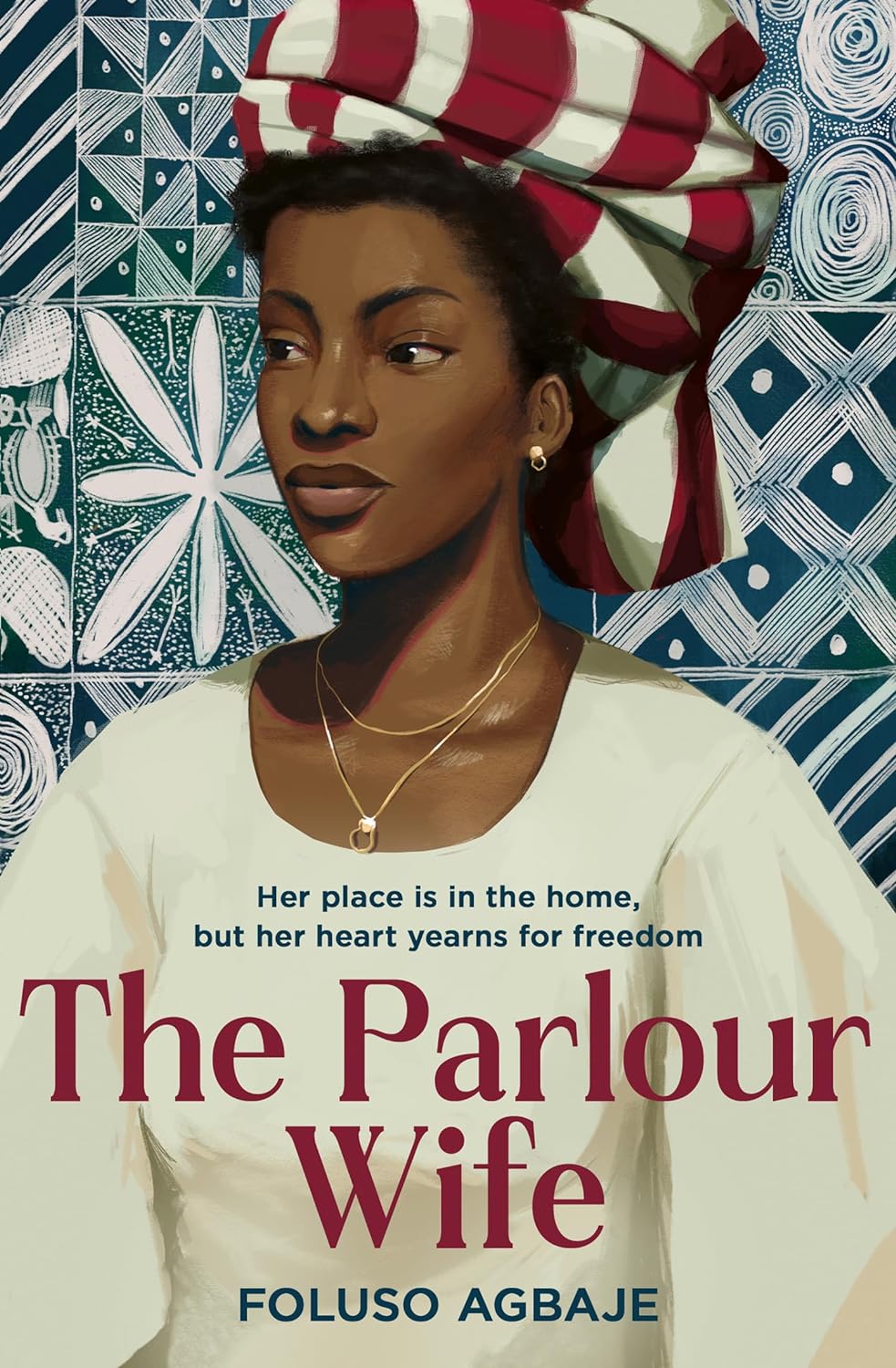
Let’s weave a story, beginning with an author. We’ll call this author Foluso Agbaje.

Foluso Agbaje is a British-Nigerian author drawn to stories entailing the complexities of culture, identity, and the overall human experience. She graduated from The Faber Academy in 2022 and subsequently published her debut novel, one near and dear to my bookshelf, The Parlour Wife. Living in Lagos, she is inspired to capture fictional stories based on true experiences of her native people. Authentic and historical are two words I’d use to represent this author’s writing style as she showcases realistic experiences surrounding real events in Nigeria within the confines of her pages. The Parlour Wife details the affairs of a young woman named Kehinde in 1940’s Lagos, Nigeria, in its pre-independent era, in the thick of a war her country refused.
Nigeria, afflicted with British occupation, found itself propelled into the bowels of World War II. Kehinde, an avid writer and feminist at heart, desires to fill a position at The West African Pilot, a liberal publication, after losing her opportunity to finish secondary school, an expense her family is unable to afford. As the male child her twin brother, Taiwo, is given the scholarship to finish his education, an offer he rejects consistently in hopes of joining the ranks of British soldiers fighting the Nazi regime. The second world war changes the trajectory of Kehinde’s life when her father is lost in a ferry accident the day after her and her twin’s 18th birthday, leaving their family without income and propelling premature marriage plans in action to provide for her mother. Her brother, in an identity crisis of his own following their father’s untimely death, joins the British military, a choice his father previously forbade and a detriment to his and Kehinde’s close-knit relationship. While Taiwo searches for belonging of his own, Kehinde is left with no choice but to become Mr. Ogunjobi’s, a rich man more than twice her age with connections in government administration, third wife.
“Iyawo parlour, that’s all you’re here for.”
Mama Tope, The Parlour Wife by Foluso Agbaje
It’s no secret that polygamy was commonplace in early twentieth century Nigeria; many men of wealth and status preferred to carry multiple wives. However, Kehinde knew this kind of arrangement would suffer her to forfeit her opportunity with The West African Pilot, a job Mr. Ogunjobi adamantly frowns upon. Tossed into an unfamiliar household already occupied by two other wives with their own children–one of which is only one year younger than she–Kehinde navigates new family dynamics (some rather unsavory), assuming her role, not only as a wife but as a sister, and finding resistance, community, and love in her new home.
Though Mr. Ogunjobi detested Kehinde’s writing position, he believed women should have respectable work, like running a snack shop, which he happily sponsored. She resolved to selling Akara, a savory treat comprised of processed beans and spices, though her woes concerning Nigeria’s political landscape continue to afflict her. As a shopkeeper witnessing her fellow merchants suffer under the crippling economy crushed by Britain’s decree to tax women though they’re excluded from suffrage, Kehinde, already radicalized by the paucity of autonomy in her own life, joins the LMWA, The Lagos Market Women’s Association, as an assistant to its leader, Madam Titi. Kehinde had previously been inspired by Madam Titi’s work and even later learns that the woman knew her father pre-mortem. This only adds to the number of secrets Kehinde conceals from her new family, specifically Mr. Ogunjobi and Mama Tope, the first wife who loathes her successors.
Kehinde finds herself fighting battles on all fronts–grappling with she and Taiwo’s tumultuous long-distance relationship, aiming to please Mr. Ogunjobi with a pregnancy she cannot conceive, coupled with her mother’s pressures to secure the family with said pregnancy, hiding secrets from her sister wives, juggling time with the LMWA and making a farce of running her snack shop, and resisting the urge to fall in love with Emeka, the brother of her neighboring merchant. Her plate expands but her palette falters, leaving all but her love affair exposed when Mama Tope finds her diary and shares its contents with their husband. Learning just how unkind the man truly can be, she finally decides to take life by the horns, a pivotal moment in understanding her identity.
“I have become so much of what everyone else wants me to be, I have forgotten who I was before this marriage.”
Kehinde, The Parlour Wife by Foluso Agbaje
Resistance becomes her fortress as she begins taking the necessary steps towards independence, mirroring the political landscape of Nigeria combating the British Empire. As protests erupt in the streets of Lagos, the same ignite within Kehinde’s womb, further fueled by an unexpected pregnancy she is certain was not planted by her husband. She has choices to make regarding her future as she is saddled with the burden of lies becoming too heavy to bear, but the choices are her own. Her story may be riddled with nuances from a time that no longer exists, but they apply nonetheless. Times have changed but people have not and as a woman who bloomed within a culture where choice seemed to be reserved for men, I find this historical fiction not only insightful but also empowering and relevant. To learn of an instrumental moment in history is one thing, but to also understand the plight of those who actually endured history is another. Amplifying titles such as this rotates the conversation around feminism and reminds us of the past we as women and feminists have worked so hard to abscond. Remember, dear reader, feminism was not birthed as a means to dominate men or perpetrate misandry; no, instead it was created to empower both women and men to make choices that serve themselves even if it doesn’t serve the patriarchy.
This title is particularly interesting to me because American curriculum covers World War II events in great depth. Reading this novel brought me to the understanding that my education wasn’t as comprehensive as I’d presumed. Western education has the habit of telling history from a lens empathetic of Europeans, while consciously omitting the violent fall out that plagued African countries. It was eye-opening to realize how simultaneously we all suffered because of the decisions of the few. This charges us with the responsibility to understand history through a more comprehensive lens, starting with titles like these.
I wholeheartedly recommend The Parlour Wife to the Braid-y Bunch of the BB. With deft imagery and an engaging plot, you’ll be transported to colonial Nigeria to gain deeper understandings of womanhood, coming-of-age, resilience, resistance, identity, and culture–one that will enhance the empathy we have for our foremothers and amplify the importance of the feminist movement in our contemporary social climate. It’s not just about the right to work or vote, each of which is respectively imperative to independence, but also the right to choose any path without reproach and judgment exacted against one’s femininity in consequence. Agbaje’s artistry complements the prevalent need to protect and educate young men and women on history and the repercussions of allowing these events to repeat. Peruse through this title if you haven’t already and share your thoughts with me. If your eyes have previously graced the binds of this novel, feel free to skip to the second step below in the comments. In the meantime, visit Agbaje’s website to learn more about her publications, including a well-anticipated title releasing in 2026, and follow her on socials to support her endeavors as an author. As always, thank you for reading.
Please like, comment, share and subscribe below if this article was your cup of tea!


Leave a reply to The Dis-education of the Negro, A Contemporary Analysis of Themes and Motifs in Sacrilege: The Curse of the Mbirwi by Nyasha Hatendi – The Braid Blog Cancel reply