

Let’s weave a story, beginning with a Tuskegee Airman. Let’s call him Second Lieutenant Esteban Hotesse.
Esteban Hotesse was born February 11, 1919 in Moca, Dominican Republic to Clara Pacheco. When he was four years old, his mother packed everything she could and carried him and his two-year-old sister, Irma, and ventured to New York City. They travelled through Ellis Island and set up residency in Manhattan. Not much is known of Esteban’s childhood, but he grew to be one of many activists in the fight for civil rights. Not only was he one of few natives of a Spanish-speaking country to serve the United States during World War II, he was the only Dominican member of the renowned Tuskegee Airmen.
The Tuskegee Airmen were the first Black military aviators in the newly integrated armed forces. They flew over 15,000 combat missions despite facing racial discrimination and segregation between 1940-1946. All 996 pilots were trained at Tuskegee Army Airfield in Alabama, the only facility for training Black pilots in the tumultuous Jim Crow era. This illustrious group of airmen fought for their country and for the right to be Black in the military. They contributed greatly to the desegregation of the U.S. military.
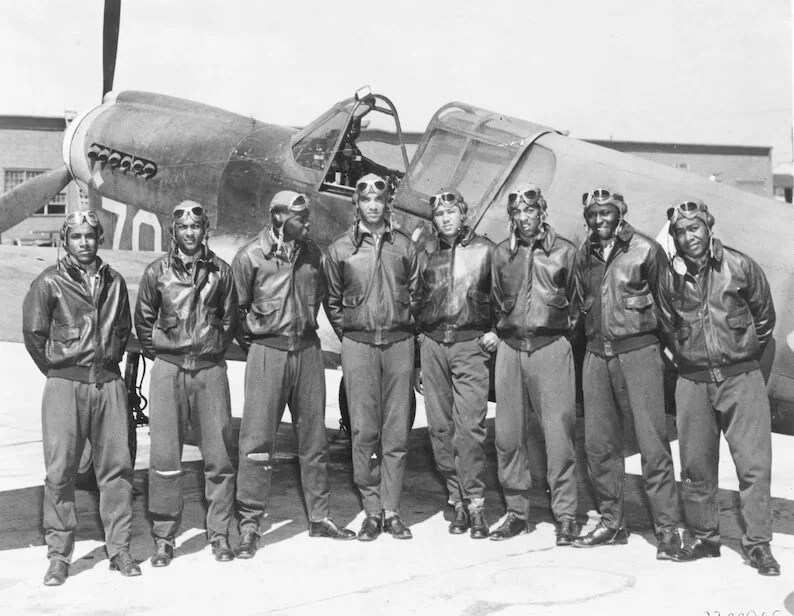
The Tuskegee Airmen comprised two groups: the 332nd Fighter Group and the 477th Bombardment Group of the United States Army Air Forces. Esteban enlisted on February 21, 1942 and was assigned to the 619th Bombardment Squadron of the 477th Bombardment Group. This group was reformed in order to work aboard B-25 bombers following pressures from prominent civil rights leaders to involve African Americans in more crucial roles. In March of 1945, the 619th began transfers from Godman Field in Kentucky to Freeman Army Airfield, about a three minute drive from Seymour, Indiana, a known Ku Klux Klan stronghold.
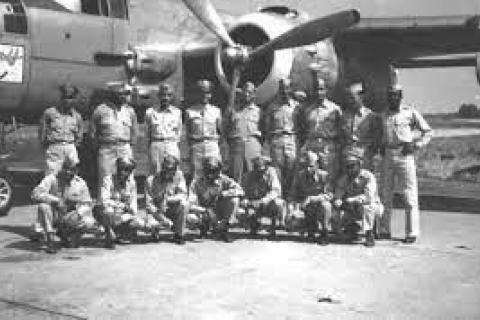
April 5, 1945 ushered the last of the 619th’s transfer rotations and upon arrival, 2LT Hotesse and his fellow airmen were greeted by Colonel Robert B. Selway. At this time, it was illegal to segregate military facilities under a law that prohibited any public building on a military installation from being used “for the accommodation of any self-constituted special or exclusive group.” Colonel Selway, however, found a loophole in the law and
divided two officers clubs for trainees and instructors. He intentionally labeled all Black officers as the former, secluding them to a substandard facility, and endowed all white officers as the latter. He issued an order surrounding his rule, which all Black officers were required to read and sign in agreement.
All 101 airmen, including 2LT Hotesse, refused to sign and for the next two days, Black officers in groups ranging from twelve to twenty peacefully entered the whites-only club and solicited service. All 101 of them were arrested and returned to Godman Field to await trial. This act of resistance would be forever known as The Freeman Field Mutiny.

When word spread of the airmen’s arrests, members of several Black organizations, labor unions, and Congress voiced their disgruntlements. Pressure from the collective voices forced Army Chief of Staff, General George C. Marshall, to release all 101 officers on April 23, 1945 with administrative reprimands placed in each of their files. Subsequently, Colonel Selway was removed as commander of Freeman Army Airfield and replaced by Colonel Benjamin O. Davis, jr. The Freeman Field Mutiny was regarded not only as a success, but as a catalyst to the Civil Rights Movement which began nine years later in 1954. 2LT Hotesse, alongside his fellow soldiers, also played a significant role in President Harry S. Truman’s decision to officially desegregate the armed forces in 1948.
While there was much to celebrate, there was still work to be done. In a tragic turn of events, 2LT Hotesse died months later on July 8, 1945 during an aircraft training exercise. He and his five-member crew took off from Godman airstrip, gaining altitude and heading toward the bombing range. After successfully completing a payload drop, his co-pilot assumed control of the aircraft, and as directed, dropped in altitude to one hundred feet above the Ohio River. Unfortunately, the plane dropped too low and crashed, killing everyone aboard. 2LT Esteban Hotesse was survived by his wife, Iristella Lind Hotesse and their two daughters. He was only twenty-six years old.
Though 2LT Hotesse and his bombardier group never saw battle during their commission, they fought in the war for domestic freedom on behalf of thousands of Black soldiers enlisted in the military. It’s because of him and the valor of the Tuskegee Airmen that I can call myself, a Black woman, an army veteran today. The fight for equity is longstanding, but we wouldn’t be here today without his bravery and resolve. This Hispanic Heritage month, let’s honor the stories of those forgotten and uplift the names of those unnoticed. The Tuskegee Airmen are known for being Black, but there was one among their ranks who was Black AND Hispanic fighting for the same freedoms, and that is worth noting. Thank you for reading.
Please like, share, and comment to expand our conversation. Subscribe below to The Plait to stay woven into each new strand posted biweekly.


Join the conversation!