
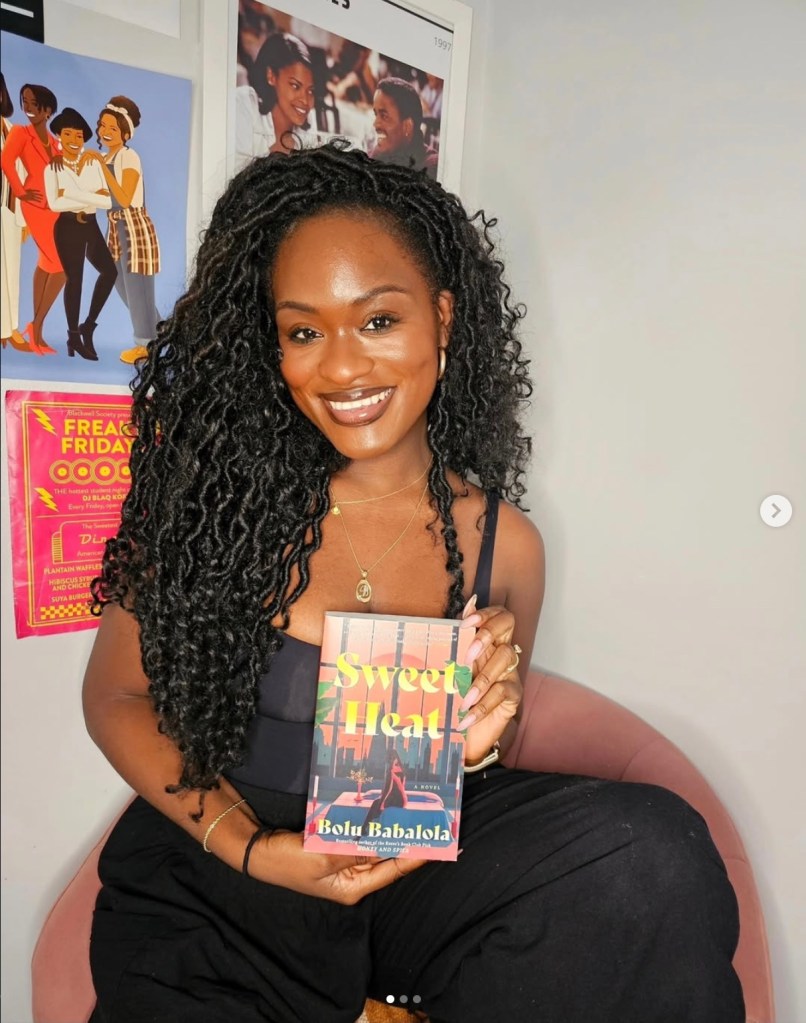
Let’s weave a story, beginning with a romance connoisseur. Let’s call her Bolu Babalola.
Bolu Babalola is a British-Nigerian author, screenwriter, journalist, and self-proclaimed “romcomossieur.” She was born February 24, 1991 in Southwark, London and obtained a Bachelor’s degree in law and a Master’s degree in American Politics and History from UCL. This dually educated, critically acclaimed, Forbes 30 under 30 lister has penned some of my favorite romance reads. Her debut anthology Love in Color (2020) became a Sunday Times Bestseller and she has maintained momentum since. She later graced bookshelves with Honey and Spice (2022), a tale of artistic college students who fall in love
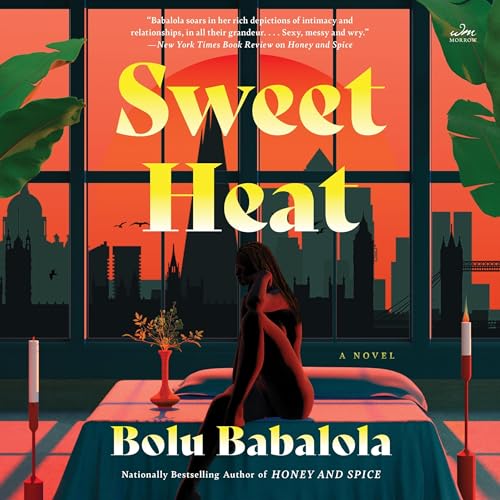
during their matriculation. While that storyline itself pulled me out of love cynical pit, it’s the sequel that left me in a heart-shaped puddle. Indeed, I’m here to gush about Sweet Heat (2025).
I was excited to once again enter Kiki Banjo’s world, but this time I met a much more sophisticated protagonist. Having completed a live tour for her romance and media podcast, The Heartbeat: Find Your Rhythm, a post-break up endeavor that landed her with a lucrative production deal with the renowned “Sound Sugar,” Kiki stirs during date night with her millionaire tech beau, Bakari. The moment is tense–I mean, wouldn’t any presupposed marriage proposal be?–but the profound narration offers readers a peak into Kiki’s perspective. She met Bakari at a media networking event marketing diet alcohol, and he was awkward but he was safe.
Kiki needed safe because she’d recently ended a romantic relationship with a successful director named Malakai. And by recently, I mean three years ago. We’ve all been there. College sweethearts turned estranged acquaintances. Weeks, months, and years pass but even thinking of that person tugs the thread that’s sewn two pieces of your heart together. Or many pieces. It’s painful, reeling… sometimes world-shattering. Yet, at times, it can be inspiring. For Kiki, it’s what inspired her popular podcast and her relationship with Bakari. He was safe because he was well-intentioned but he wasn’t thoughtful. She didn’t feel the need to expose the crevices of herself she had with Malakai, the forgone ex-boyfriend. With Bakari, she didn’t have to risk experiencing that kind of pain again, which is why she dreaded the idea of him asking to marry her. And it’s also why she impulsively interrupted his speech, exclaiming, “I can’t marry you!”
Cue the drama.
Not the kind of drama you’d think, nonetheless. Bakari had no intention of popping the question–no. Instead, he deigned to request that Kiki come work for his company. A much worse request if you ask Kiki (and me). I held my breath for this entire scene, afraid of what was to come of this uncomfortable conversation, and I finally released a deep exhale when Aminah, Kiki’s bubbly best friend calls to announce she’s getting married to her beloved boyfriend, Kofi. Who also happens to be Malakai’s best friend.
“And what’s the value of ‘safer’ anyway, if nothing precious is at stake?”
– Bolu Babalola, Sweet Heat (2025)
I’m sure Kiki was just as relieved to get a bit of respite from that moment with Bakari as I was just reading it, which is why I wasn’t at all shocked when it became abundantly clear in the following scene that the two part ways–sort of. You know that icky in-between right after a break-up where everyone doesn’t yet know you’re no longer together so you’re both kind of one-foot-in-one-foot-out of each other’s lives? Yeah, just imagine.
Malakai and Kiki first reconnect at Aminah and Kofi’s engagement party in an initially taut encounter, but the night melts into a steamy night of passion, memory, and release–in more ways than one. The one-time fling was harmless, they thought, and it would be the only time they’d interact with one another while Malakai was in London.
This book wouldn’t be a proper romance if that were the case.
Not only are they saddled with maid of honor and best man responsibilities, they also find themselves collaborating on a project neither of them can afford to forsake. Dealing with her parents’ retirement, her best friend’s wedding (which creates drama in itself), and the weight of creative direction, Kiki falls down a rabbit hole that requires her to finally address the introspection she’d spent years avoiding. She’s had to pivot and rebuild and reconstruct so many things in her life, yet she watches it all fall apart once again. But what she doesn’t realize is that all the walls she’d built were boxing in her into a glass fortress made of fear–her relationships, her career, even the thought of losing her parents’ restaurant, Shakara–all delicately composed to ensure change never vexed her.
And then there’s the issue of love. Does she continue playing it safe with Bakari or does she step into what could’ve been with Malakai?
That’s what I love about this book. It’s often romance novels are unilateral in plot, solely focusing on the issue of to-love-or-not-to-love. Readers can relate to Kiki because every aspect of her life intertwines to paint the bigger picture. We get to know our sensual protagonist as avoidant despite craving connection (even if she convinces herself otherwise), creative but caught at a roadblock, headstrong and determined, even if these qualities protect her from the life she deserves. Whether tomorrow’s choices revolve around next steps in life, watching our friendships blossom and crumble, supporting our families, changing careers, or finding love, it’s never easy relinquishing control of what you already know–what already feels safe. Our twenty-somethings bring us to these seasons often and like Kiki, we’re saddled with the decision to love and hold on or love and let go. It’s why books like this one are so important. They teach us lessons in life and love because though they are fiction, they are speculative, meaning this can be someone’s true story. Often, they’re so similar to our own, each scene is like having asked your bestie for advice and listening to her tell you everything will work itself out perfectly. It’s like watching your sister choose herself and grow from the experience. It’s like peering into a world where Black women are cherished and loved properly (because who doesn’t appreciate a reprieve from struggle love?) It’s why I implore you to embark on this spicy journey with Kikiola in Sweet Heat by Bolu Babalola. Thank you for reading.
Have you already scoured the pages of this riveting read? Share your thoughts! What were your favorite parts of the book? Would you recommend it to your friends? Or have you read any other titles by Bolu Babalola?
Please like, comment, and share to expand our conversation. Scroll just a little further to subscribe to The Plait, a newsletter that will keep you braided into each new strand.


Join the conversation!